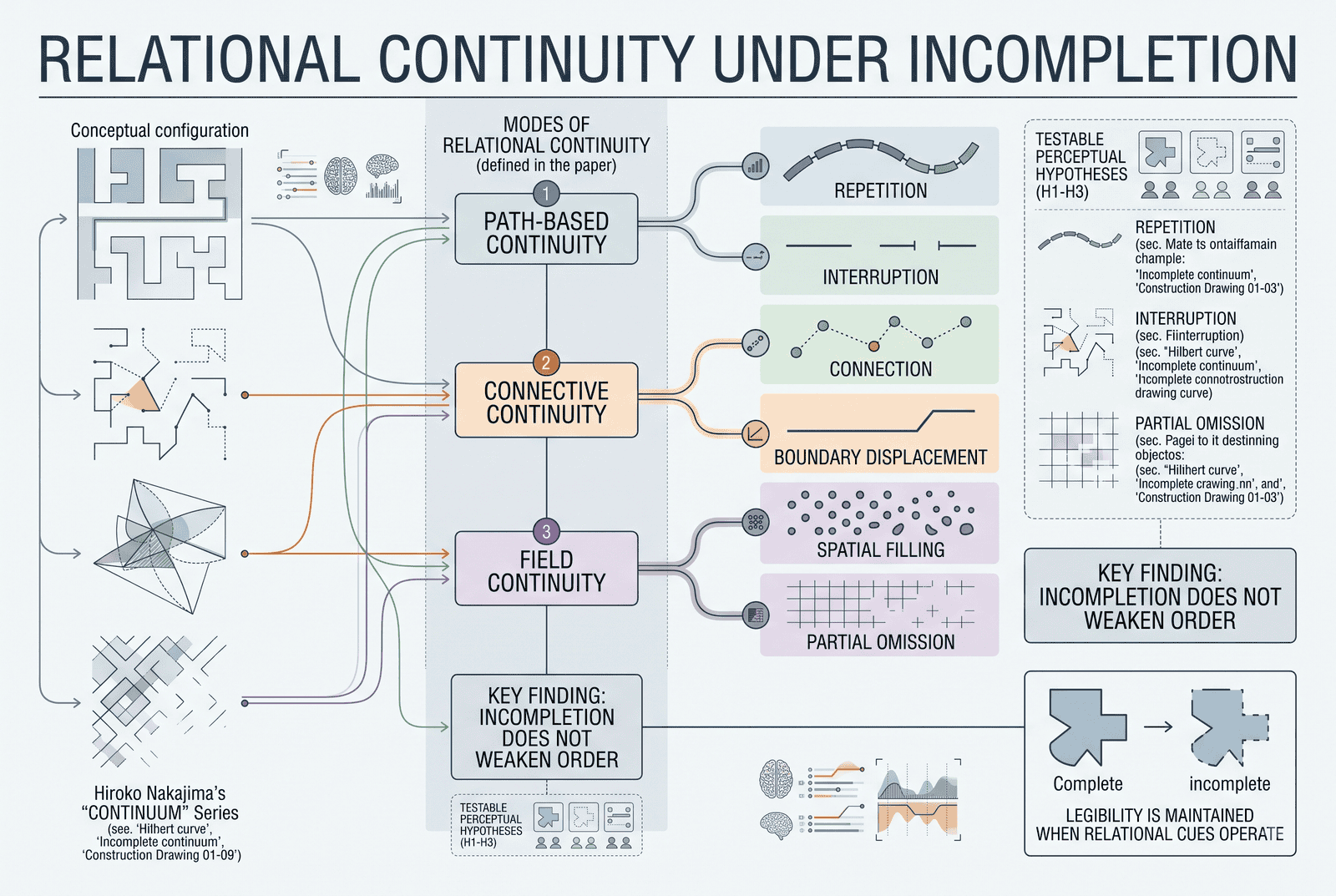
Visual continuity is conventionally associated with closure, repeated units, or intact outlines, yet many visual-design contexts require coherence under cropping, interruption, displacement, and omission, where existing perceptual and shape-analytic accounts provide no work-level descriptive vocabulary. This paper addresses that gap with three objectives: to define a set of visible formal operations by which incomplete geometric configurations remain coherent, to organize these operations into recurrent modes of continuity, and to formulate testable perceptual hypotheses. Through qualitative formal analysis of selected documented work states from Hiroko Nakajima’s CONTINUUM series—Hilbert curve (2021), Incomplete continuum (2021), and Construction Drawing 01–03 (2021)—the study identifies six operations: repetition, connection, spatial filling, interruption, boundary displacement, and partial omission, each grounded jointly in observable features of the works and in prior accounts from Gestalt psychology, perceptual completion research, shape analysis, and design cognition. These operations are organized into three modes of relational continuity—path-based, connective, and field continuity. The principal finding is that incompletion need not weaken order when relational cues remain operative; under specific conditions it can make relational structure more legible. Three falsifiable hypotheses (H1–H3) are formulated to bridge this qualitative, work-level description toward future quantitative perceptual and applied-design evaluation.
Nakajima H, Matsukura H, Sakamoto M. Designing continuity without closure: a morphological framework for incomplete geometric configurations, Res. Des. 2026; 3(2): 79-94. DOI: http://dx.doi.org/10.17515/rede2026-030ae0527rs