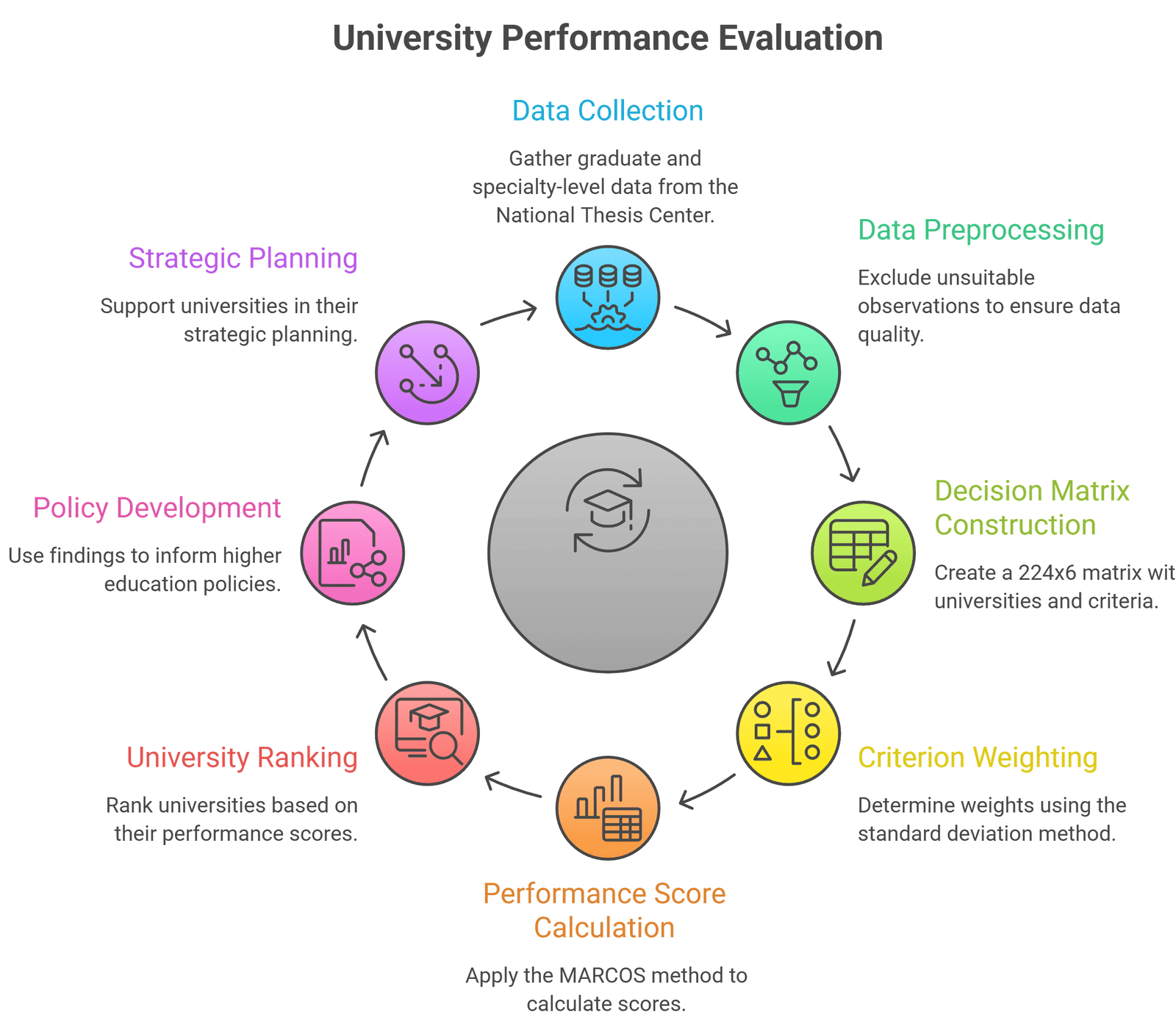
This study analyzes the performance of universities operating in Türkiye based on the number of graduate and specialty-level graduates by employing a multi-criteria decision-making (MCDM) approach. The dataset used in the research was obtained from the National Thesis Center’s May 2026 database, and observations deemed unsuitable during the data preprocessing stage were excluded from the analysis. As a result, a final decision matrix consisting of 224 alternatives and 6 criteria (224×6) was constructed. Within the scope of the analysis, criterion weights were determined using the standard deviation method, an objective weighting technique that reflects the variability among criteria in the decision-making process. Subsequently, the MARCOS method was applied to calculate the performance scores of universities and establish their rankings. The findings revealed that Istanbul University, Gazi University, Marmara University, Hacettepe University, and Ankara University were the highest-performing universities. Their strong academic infrastructures, wide range of graduate programs, and high research capacities played a significant role in securing top positions in the ranking. In contrast, universities ranked at the lower end of the list were observed to possess more limited graduate education capacities. The results demonstrate that substantial differences exist among universities in Türkiye regarding graduate-level output. In conclusion, the integrated use of the standard deviation and MARCOS methods provided an objective and comparable framework for evaluating university performance. The study is expected to contribute to the development of higher education policies and support the strategic planning processes of universities.
Yalçıner Çal D. Ranking universities’ graduate education performances through multi-criteria decision-making methods, Res. Des. 2026; 3(1): 17-32. DOI: http://dx.doi.org/10.17515/rede2026-019da0203rs