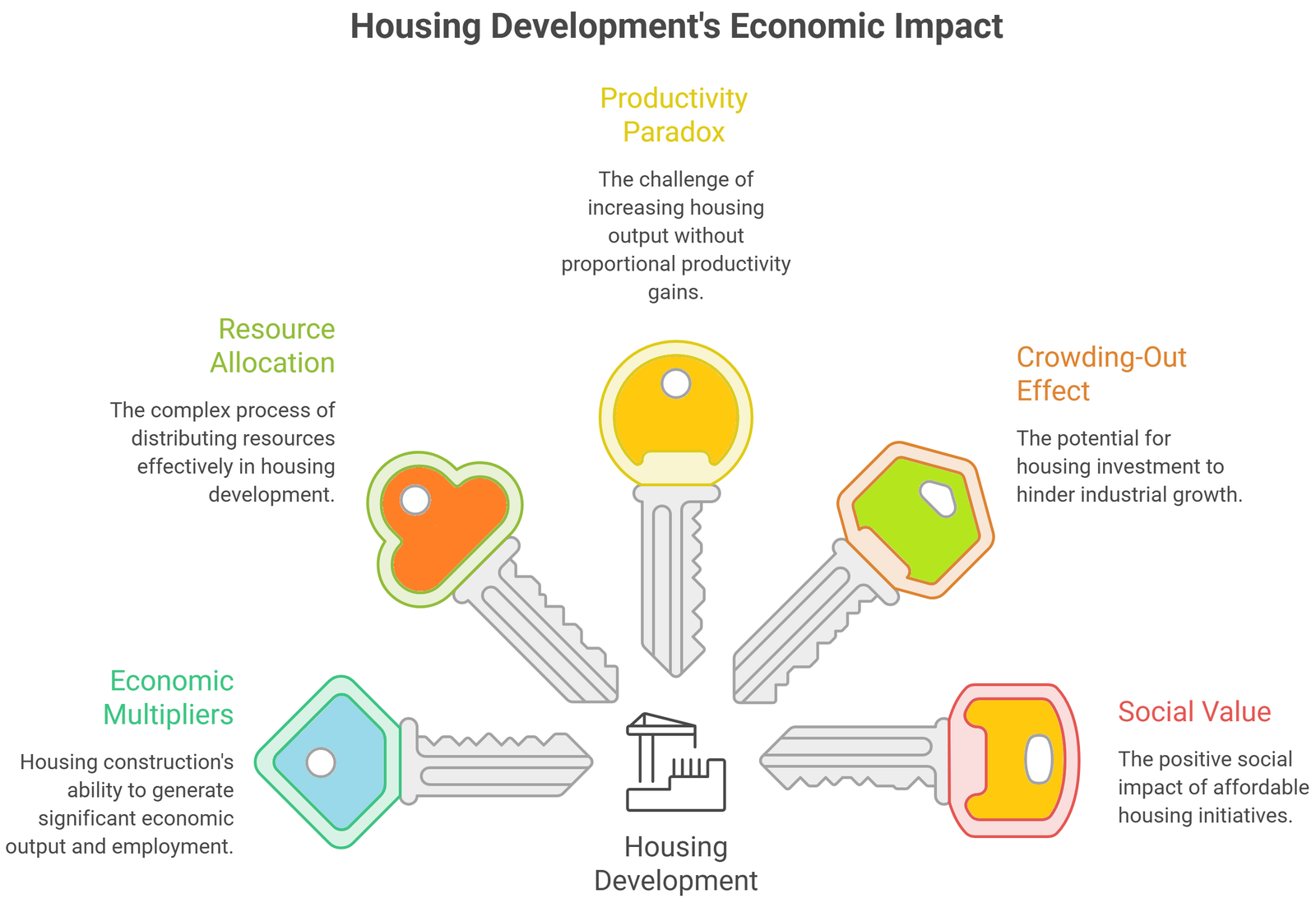
While housing development generates substantial output and employment multipliers that accelerate domestic monetary velocity, its hyper-financialization introduces severe macroeconomic vulnerabilities. The economic impact of housing construction is characterized by high multipliers and complex resource allocations. Quantifying these effects reveals that in specific contexts, such as Australia, every $1 million in residential output generates $2.9 million in total economic output and sustains nine jobs. While housing acts as a significant catalyst, the sector faces a global productivity paradox and substantial risks of resource misallocation. For instance, China exhibits a 22.4% vacancy rate, highlighting potential inefficiencies in large-scale residential development. Furthermore, housing construction can exert a crowding-out effect on industrial investment, potentially hindering broader manufacturing growth. Despite these challenges, targeted investments in affordable housing demonstrate significant social value, with Social Return on Investment (SROI) ratios reaching up to 1 to 3.22. This research suggests that while residential development is a powerful economic engine, its efficacy depends on balancing immediate output with long-term industrial health and occupancy stability. Strategic planning is required to mitigate the productivity gap and ensure that the substantial economic multipliers of housing construction translate into sustainable national growth without depleting resources from other vital sectors.
Arıcan M, Şeker S. The macroeconomic impact of residential construction on national productivity, Res. Des. 2026; 3(1): 65-77. DOI: http://dx.doi.org/10.17515/rede2026-020ec1103rs