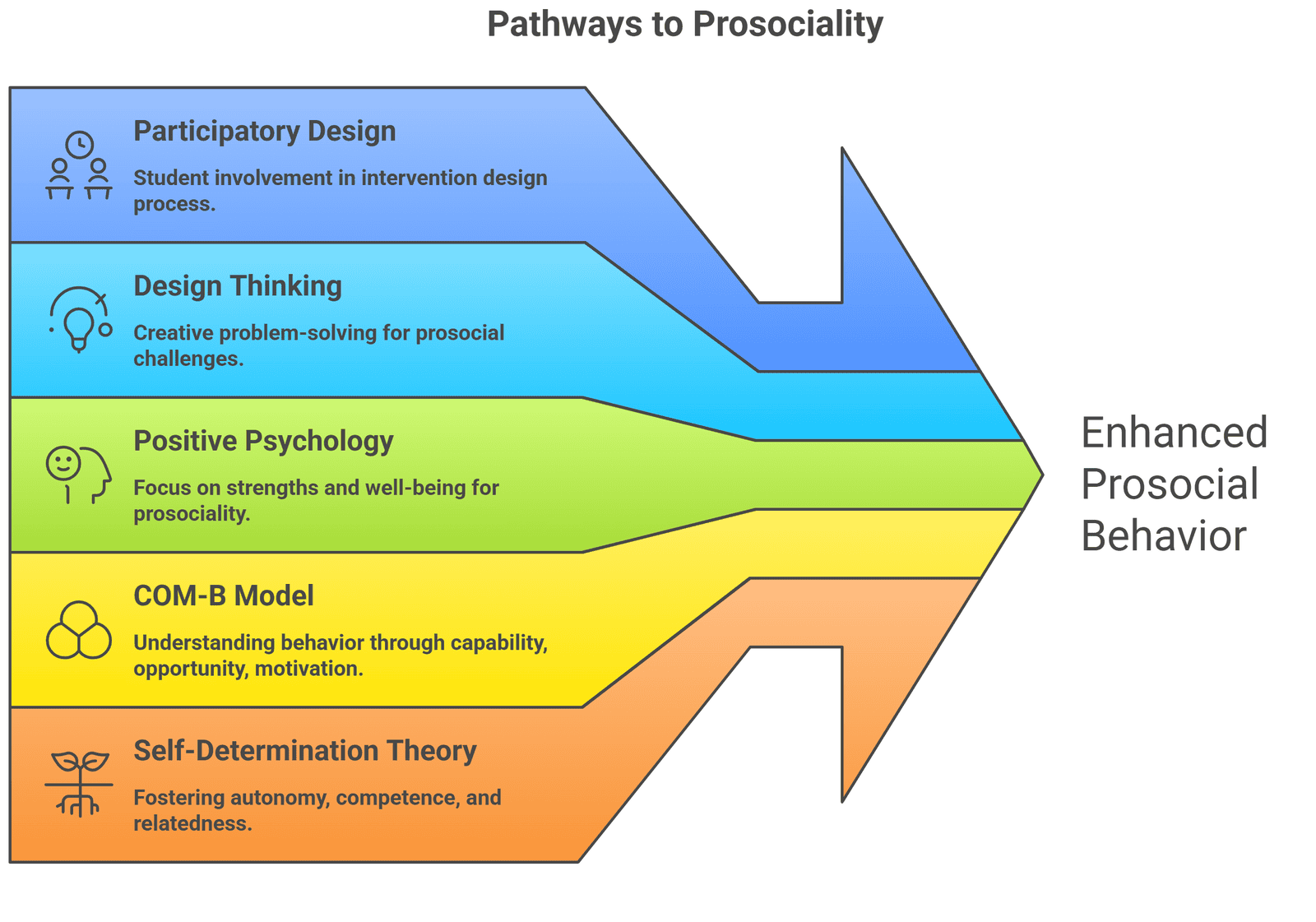
This study presents a design and methodology paper that proposes a structured, theory-driven educational intervention to support prosocial behavior in emerging adulthood. Well-being is closely linked not only to individual satisfaction but also to social connectedness and resilience. Prosocial behaviors—deliberate acts of helping, sharing, and supporting others—emerge as fundamental determinants of both individual and collective well-being in this context. Emerging adulthood (ages 18–25) represents a critical developmental stage in which identity exploration and the formation of social roles take place, thereby offering an essential opportunity for educational interventions aimed at fostering prosociality. However, the literature reveals a scarcity of concrete applications specifically designed for this age group within the context of higher education. Addressing this gap, the present study aims to develop and propose a structured, theory-driven educational intervention that integrates design-based approaches with psychological frameworks to support prosocial behavior in emerging adulthood. This study proposes a 14-week course plan that integrates Participatory Design, Design Thinking, and Positive Psychology approaches to enhance university students’ prosocial motivation. The COM-B model (capability, opportunity, motivation) and Self-Determination Theory (autonomy, competence, relatedness) constitute the theoretical foundation of the intervention. The unique contribution of this study lies in combining design education methodologies with behavior change theories to offer a scalable and practice-oriented intervention model tailored for higher education contexts. The research will be conducted using a quasi-experimental design with both experimental and control groups. Quantitative data will be collected through the VIA Character Strengths, Adult Prosociality, Basic Empathy, Psychological Need Satisfaction, PERMA well-being, and General Belongingness scales. In contrast, qualitative data will be obtained through interviews and focus group studies. The evaluation of the intervention’s impact will be conducted in the subsequent main study, following the methodology proposed in this article.
Avcıoğlu BÇ, Başak H. Fostering well-being in emerging adults through prosocial behavior: an intervention design proposal for higher education, Res. Des. 2026; 3(1): 33-49. DOI: http://dx.doi.org/10.17515/rede2026-021da1103rs